Super Simple Movement for Early Recovery
A privacy-first workout companion for people rebuilding life after addiction. Simple, flexible movement tracking that meets you where you are and grows with your recovery.
Kairo (καιρός) —the right, critical, or opportune moment
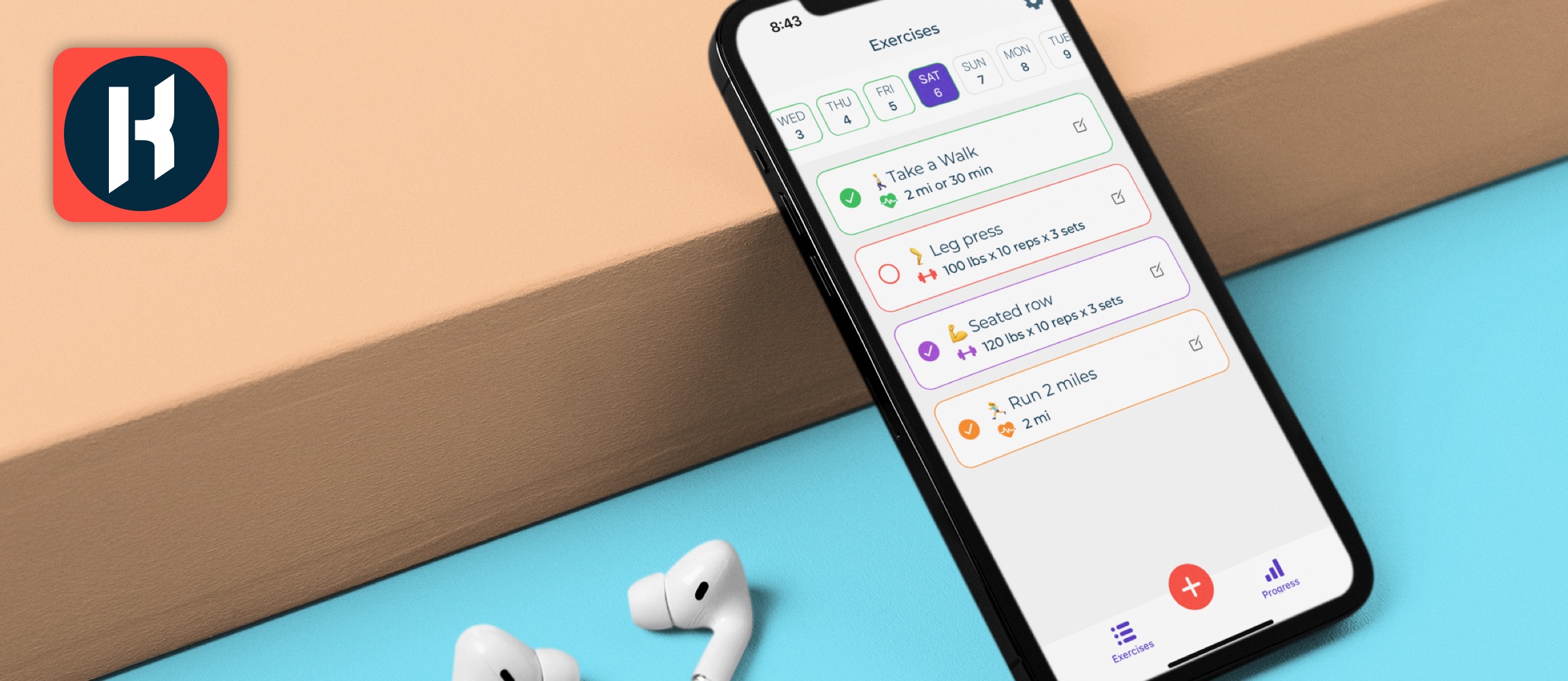
Coming to iOS and Android stores in early 2026
Background
When people first enter recovery, they're often told some version of:
"Work the steps. Go to meetings. Help others. Take care of your body."
The first three usually get structure and support. The last one is often left as a vague suggestion.
Years of active addiction frequently come with poor sleep, lousy nutrition, and almost no intentional movement. At the same time, there's a growing body of research showing that regular exercise can ease anxiety and depression, support brain healing, and even help reduce relapse risk in substance use disorders.
But when you're newly sober, exhausted, and fragile, most fitness tools feel like they're made for someone else entirely.
Kairo was born out of that gap.
Jeff, founder of UpStart Productions, designed Kairo for his own early recovery. He needed a workout app that didn't assume he was an athlete, didn't drown him in macros and periodization, and didn't shame him for starting with "walk 10 minutes a day and call it a win." Every app he tried felt professional while he felt like a timid amateur just trying to stay sober one day at a time.
Kairo grew from that lived experience: a super simple, beginner-first workout app, imagined as part of the same recovery support suite as Nepho, UpStart's AA 12-step companion.
The Challenge
Early recovery is already overloaded:
- Detoxing body and brain
- Going to meetings, therapy, and appointments
- Learning to live without your primary coping tool
- Rebuilding relationships, finances, and daily structure
In that context, "start working out" can feel like one more impossible assignment. So these are the specific challenges we're designing Kairo around:
- Overwhelm & shame. Most fitness apps assume baseline health, confidence, and energy. Newly sober users often have none of those.
- Rigid workout plans. Many tools lock you into predefined programs, machines, or gym settings that don't match real life ("I don't have a squat rack; I have a gravel driveway and a jump rope").
- All-or-nothing thinking. Addicts in early recovery are famous for perfectionism: if they can't do it "right," they often don't do it at all.
- Cognitive load. Recovery already demands huge mental energy. Complex dashboards, metrics, and streaks can tip someone from "motivated" into "forget it."
- Fragmented recovery supports. Spiritual work, mental health, and physical health are often tracked in completely separate apps, if they're tracked at all, making it hard to see the whole picture.
Jeff wanted to know: "How can we make starting to move again feel as gentle and accessible as taking a newcomer chip?"
Our Approach
We approached Kairo not as a "fitness product" first, but as a recovery support tool that happens to be about movement. The key design principles are:
- Start where you really are. If today's win is "walk to the end of the block," the app should treat that as legitimate progress, not a failure to hit 10,000 steps.
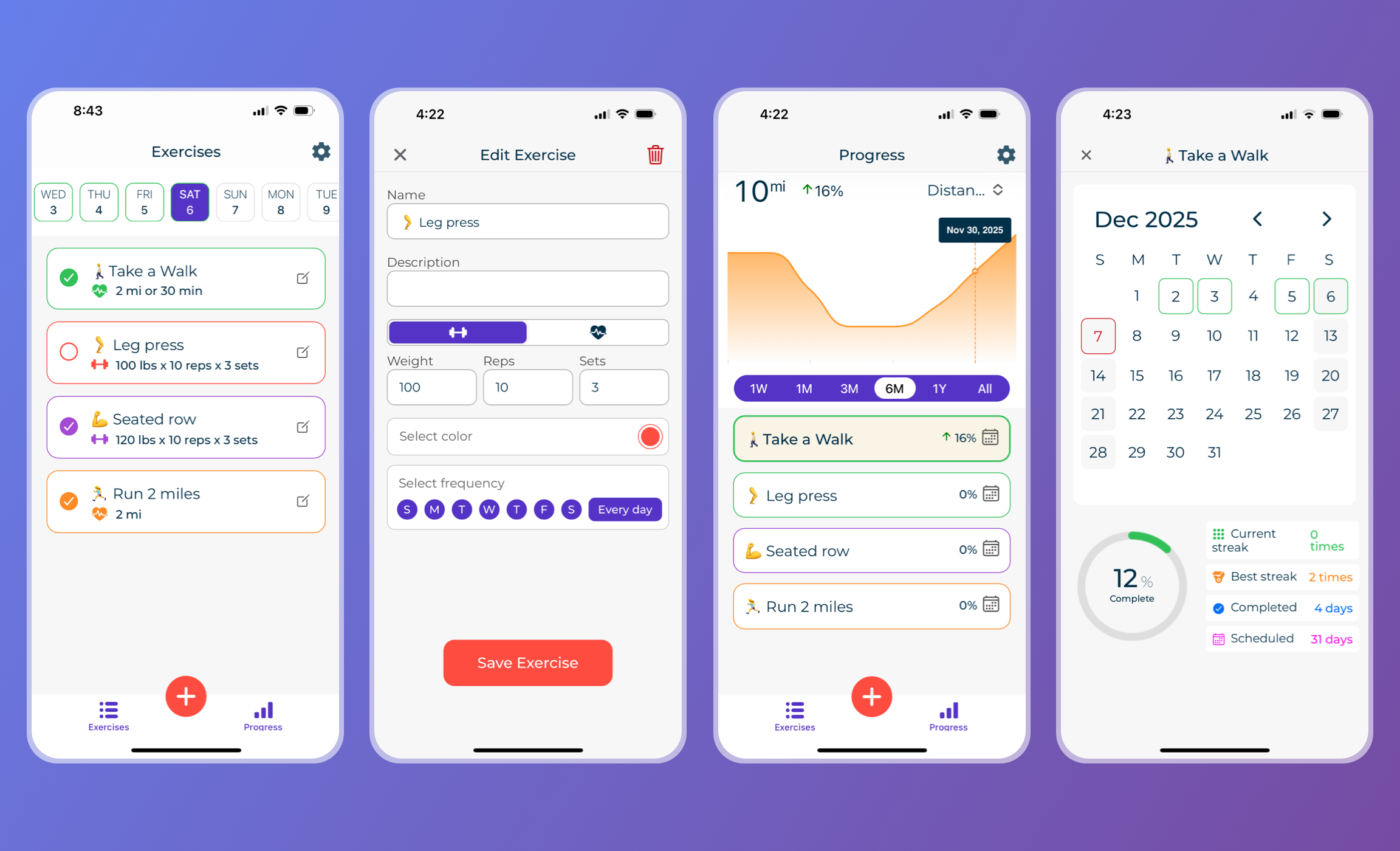
- Radically simple, totally flexible. Kairo doesn't tell you what counts as a workout. You define it: "Walk 1 mile," "Lift heavy rock 8 times," "Treadmill 10 minutes, easy pace," "Stretch on the living room floor for 5 minutes."
- Recovery-aware, not recovery-exploitative. Language, flows, and nudges are built to be compatible with 12-step and other recovery frameworks without impersonating a sponsor, counselor, or medical provider.
- Low friction beats high features. If you can't log a workout in under 20 seconds, it's too complicated. Kairo optimizes for tiny, repeatable actions over elaborate plans.
- Privacy-first by default. People rebuilding their lives deserve tools that don't monetize their struggles. Kairo is designed to keep data minimal, device local, and transparent about what's stored and why.
- Designed by someone who's lived it. Jeff's own early recovery experience keeps Kairo anchored: if it wouldn't have worked for him at 30 days sober, it doesn't belong in Kairo v1.

I built Kairo because I needed a workout app that didn't assume I was an athlete. When I was 30 days sober, I asked myself: "How can I make starting to move again feel as gentle and accessible as taking a newcomer chip?" Kairo's core philosophy is: Name an exercise. Do it. Mark it done. See your progress over time. If you can't log a workout in 20 seconds or less, it's too complicated. If it wouldn't have worked for me at 30 days sober, it doesn't belong in Kairo.
Jeff
Founder, UpStart Productions
The Result
Even before a public launch, early use of Kairo in Jeff's own recovery, and in quiet pilot testing with a few trusted peers, has shown something simple but powerful:
People who once felt intimidated by "fitness" are suddenly willing to move.
Instead of wrestling with complex programs or feeling judged by pro-level tracking, they open Kairo, add a plain-language exercise like "Walk around the block" or "Lift heavy rock 8 times," tap that they did it. Over time, they see a gentle graph that says, "You're showing up."
The result isn't six-pack abs or perfect streaks. It's a subtle but meaningful shift:
- from I should be working out to I actually did a little something today
- from I'm so far behind to I'm slowly trending in the right direction
Our hope is that, as Kairo rolls out more broadly, that small, repeatable success experience becomes part of the recovery toolkit, alongside meetings, step work, and spiritual practice.
Why It Matters
For people in early recovery, complexity is the enemy. Life already feels like a full-time job of "figuring things out." By keeping movement as simple as:
"Name an exercise. Do it. Mark it done. See your progress over time."
Kairo lowers the barrier between intention and action.
This matters because:
- Tiny, honored commitments rebuild trust. When someone says, "I'll walk 10 minutes" and then actually logs it, they get a small, evidence-based reminder that they can keep promises to themselves.
- Embodied progress supports emotional and spiritual work. Recovery is not just in the head or on the page; it lives in the body. As users see their own upward-tilting progress graphs, they're reminded that change is happening in real life—not just in theory.
- It treats physical health as part of sobriety, not an optional extra. Kairo quietly reinforces the idea that taking care of the body is a legitimate pillar of recovery, right alongside meditation, journaling, and service.
In short, Kairo matters because it turns "I should really start exercising" into one of the smallest, kindest, most doable actions a person in recovery can take today, and then shows them, visually and simply, that those actions are adding up.